Free Technical Webinar
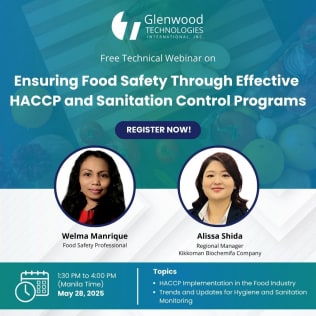
Are you doing enough to safeguard your food products from hidden hazards and contamination risks? Ensuring food safety demands a strong, integrated approach that incorporates both effective HACCP (Hazard Analysis and Critical Control Points) and sanitation control programs. HACCP focuses on systematically identifying, assessing, and managing potential hazards throughout food production, while sanitation programs uphold hygiene standards to prevent contamination. When implemented together, these systems minimize food safety risks, ensure compliance with regulatory requirements, and protect consumer health by maintaining consistent control over critical processes, and proper hygiene and sanitation throughout the supply chain.
In this FREE technical webinar, industry experts will guide you through best practices, regulatory expectations, and real-world applications of HACCP principles and sanitation strategies. Learn how to design, implement, and monitor complex food safety systems that minimizes risks, enhance operational efficiency, and ensure product integrity from production to consumption.
WEBINAR DETAILS
HACCP Implementation in the Food Industry Speaker
Ms. Welma Manrique is an expert in food safety and quality management, holding certifications as a Lead Auditor for BRCGS Food Issue 9 and FSSC 22000. She holds a Bachelor of Science in Food Technology from Bicol University in the Philippines. Ms. Welma has extensive knowledge of various international standards, including ISO 22000, HACCP, and sustainability practices like TACCP/VACCP. She is experienced in improving systems, managing risks, and ensuring the continuous quality and safety of food products. She believes that strong product quality speaks for itself and that continuous training and the right skills are key to long-term success in any organization.
Trends and Updates for Hygiene and Sanitation Monitoring Speaker
Ms. Alissa Shida is a Microbiology Specialist and Forensic Science Expert with a Master's degree in Forensic Science and a Bachelor's degree in Microbiology. Currently serving as the Regional Manager at Kikkoman Biochemifa Company, she and her team provide advanced hygiene testing solutions to various industries, ensuring compliance with safety standards. With a focus on microbiological analysis and contaminant detection, Ms. Alissa is committed to staying at the forefront of the field, delivering innovative solutions, and maintaining high industry standards.
Don't miss out on this excellent learning opportunity! Whether enhancing your existing programs or developing a new one, this session will equip you with key insights and practical tools to elevate your food safety performance. The electronic copy of the certificates will be issued to attendees 2-3 weeks after the webinar. For any questions or clarifications, send an email to gabriellellamas@glenwood.ph
Free Technical Webinar
Are you doing enough to safeguard your food products from hidden hazards and contamination risks? Ensuring food safety demands a strong, integrated approach that incorporates both effective HACCP (Hazard Analysis and Critical Control Points) and sanitation control programs. HACCP focuses on systematically identifying, assessing, and managing potential hazards throughout food production, while sanitation programs uphold hygiene standards to prevent contamination. When implemented together, these systems minimize food safety risks, ensure compliance with regulatory requirements, and protect consumer health by maintaining consistent control over critical processes, and proper hygiene and sanitation throughout the supply chain.
In this FREE technical webinar, industry experts will guide you through best practices, regulatory expectations, and real-world applications of HACCP principles and sanitation strategies. Learn how to design, implement, and monitor complex food safety systems that minimizes risks, enhance operational efficiency, and ensure product integrity from production to consumption.
WEBINAR DETAILS
HACCP Implementation in the Food Industry Speaker
Ms. Welma Manrique is an expert in food safety and quality management, holding certifications as a Lead Auditor for BRCGS Food Issue 9 and FSSC 22000. She holds a Bachelor of Science in Food Technology from Bicol University in the Philippines. Ms. Welma has extensive knowledge of various international standards, including ISO 22000, HACCP, and sustainability practices like TACCP/VACCP. She is experienced in improving systems, managing risks, and ensuring the continuous quality and safety of food products. She believes that strong product quality speaks for itself and that continuous training and the right skills are key to long-term success in any organization.
Trends and Updates for Hygiene and Sanitation Monitoring Speaker
Ms. Alissa Shida is a Microbiology Specialist and Forensic Science Expert with a Master's degree in Forensic Science and a Bachelor's degree in Microbiology. Currently serving as the Regional Manager at Kikkoman Biochemifa Company, she and her team provide advanced hygiene testing solutions to various industries, ensuring compliance with safety standards. With a focus on microbiological analysis and contaminant detection, Ms. Alissa is committed to staying at the forefront of the field, delivering innovative solutions, and maintaining high industry standards.
Don't miss out on this excellent learning opportunity! Whether enhancing your existing programs or developing a new one, this session will equip you with key insights and practical tools to elevate your food safety performance. The electronic copy of the certificates will be issued to attendees 2-3 weeks after the webinar. For any questions or clarifications, send an email to gabriellellamas@glenwood.ph