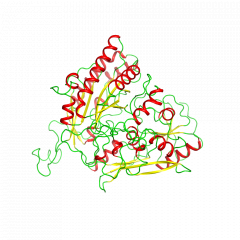
Cholesterol oxidase (CHO-BE) *Under development

  • Enzymes for Clinical Chemistry

The enzyme is useful for the determination of cholesterol in clinical analysis.


Img. Ref.:NAR 46: W296–W303 (2018)

Origin Recombinant Escherichia coli
Systematic name

Cholesterol : oxygen oxidoreductase

EC Number 1.1.3.6
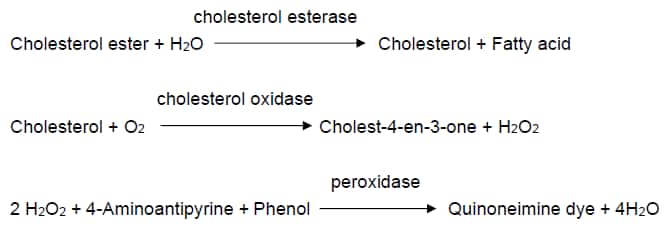
Reaction formula

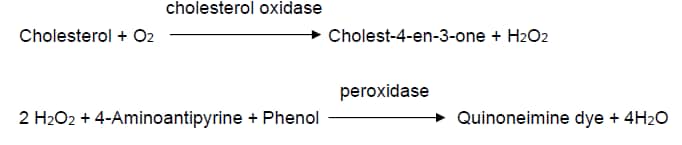
Cholesterol + O2 →→→ Cholest-4-en-3-one + H2O2

SPECIFICATION

Appearance Light yellow to yellow lyophilizate
Activity ≧10 U/mg
Stabilizer Sucrose
Storage below -20℃

PROPERTIES

Molecular weight ca. 57 kDa (SDS-PAGE)
Structure monomer
Michaelis constant 1.6×10⁻⁵ M (cholesterol)
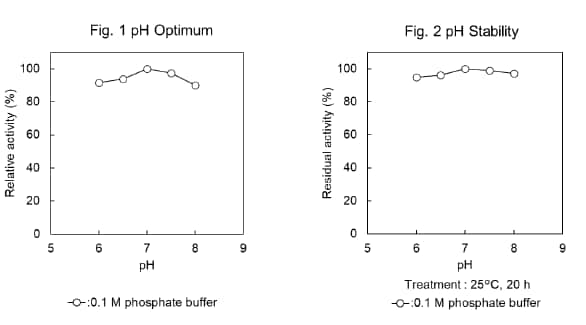
pH Optimum pH 6.0 – 8.0   (Fig. 1)
pH Stability pH 6.0 – 8.0   (Fig. 2)
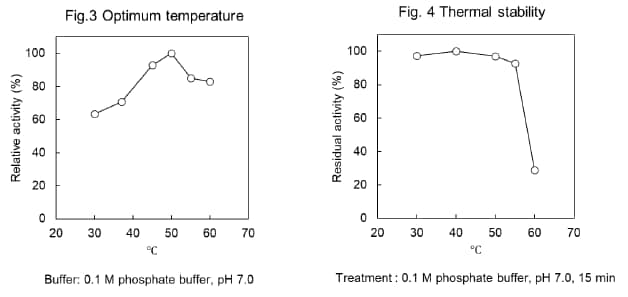
Optimum temperature 45 – 50°C    (Fig. 3)
Thermal stability below 55°C    (Fig. 4)

APPLICATIONS

The enzyme is useful for the determination of cholesterol in clinical analysis.

ASSAY PROCEDURE

Principle

The appearance of quinoneimine dye is measured spectrophotometrically at 500 nm.

Definition of unit

One unit (U) is defined as the amount of enzyme which produces 1 μmol of hydrogen peroxide per min at 37℃ and pH 7.0 under the conditions described below.

Reagents

  1. Potassium phosphate buffer, 0.1 M; pH 7.0: mix 0.1 M KH2PO4 solution and 0.1 M K2HPO4 solution to make a pH 7.0 solution.
  2. Cholesterol solution, 0.5%: dissolve 500 mg of cholesterol in 5.0 mL of Triton X-100 with heating. Add 90 mL of distilled water to the hot cholesterol–Triton X-100 solution by slowly pouring. Stir and boil for 30–60 s. Cool under running water with gentle agitation. Dissolve 4.0 g of sodium cholate in the cholesterol–Triton X-100 solution and dilute with distilled water to 100 mL. This solution is stable for about one week at room temperature. If it becomes cloudy, warm sligtly with stirring until it becomes clear.
  3. 4-Aminoantipyrine (4-AA) solution, 1.76%: 1.76 g of 4-AA/100 mL of distilled water.
  4. Phenol solution, 6.0%: 6.0 g of phenol/100 mL of distilled water.
  5. Peroxidase (POD) solution, 150 U/mL: 75 mg of POD (200 guaiacol U/mg)/100 mL of potassium phosphate buffer (Reagent A).
  6. Enzyme dilution buffer: 20 mm potassium phosphate buffer, pH 7.0, containing 0.2% bovine serum albumin (BSA).

Sample: dissolve the lyophilized enzyme to a volume activity of 0.1–0.5 U/mL with ice-cold enzyme dilution buffer (Reagent F).

Procedure

  1. Pipette the following reagents into a cuvette (light path: 1 cm).
    2.55 mL Potassium phosphate buffer (Reagent A)
    0.20 mL Cholesterol solution (Reagent B)
    0.05 mL 4-AA solution (Reagent C)
    0.10 mL Phenol solution (Reagent D)
    0.10 mL POD solution (Reagent E)
  2. Equilibrate at 37℃ for about 5 min.
  3. Add 0.05 mL of sample and mix.
  4. Record the increase of absorbance at 500 nm in a spectrophotometer thermostated at 37℃ and calculate the ΔA per min using the linear portion of the curve (ΔAS).
    The blank solution is prepared by adding enzyme dilution buffer (Reagent F) instead of sample (ΔA0).

Calculation

Activity can be calculated by using the following formula:

13.8 : Millimolar extinction coefficient of quinoneimine dye under the assay conditions (cm2/μmol)
1/2 : Factor based on the fact that 1 mol of hydrogen peroxide produces 1/2 mol of quinoneimine dye
df : Dilution factor
C : Content of cholesterol oxidase preparation in sample (mg/mL)

EXPERIMENTAL DATA

REFERENCES

  • Coulombe, R. et al., J. Biol. Chem., 276, 30435–30441 (2001).
  • Caldinelli, L. et al., J. Biol. Chem., 280, 22572–22581 (2005).

TOP