



Past exhibition
-
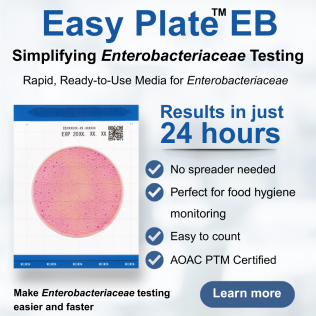
Evaluation of Easy Plate EB for Enterobacteriaceae enumeration using ISO 16140-2, and AOAC certification standards
Introduction:
Enterobacteriaceae are important hygiene indicators in food and food processing environments. Easy Plate EB (E-EB) is a ready-to-use dry medium that enables Enterobacteriaceae enumeration within 24 hours and supports automated colony counting using CCS.
Purpose:
This study evaluated the performance of Easy Plate EB for Enterobacteriaceae enumeration according to ISO 16140-2 and AOAC validation standards. The suitability of automated colony counting with CCS was also assessed.
Method:
E-EB was compared with the ISO 21528-2:2017 reference method using 105 food and environmental samples. Inclusivity, exclusivity, relative trueness, and automated colony counting performance were evaluated.
Results:
E-EB demonstrated selectivity comparable to conventional VRBG agar and showed good agreement with the ISO reference method (R2 = 0.964). Automated counting with CCS also correlated strongly with manual counting (R2 = 0.996), confirming accurate colony enumeration.
Significance:
Easy Plate EB provides reliable Enterobacteriaceae enumeration with a simple and efficient workflow. When combined with CCS, it can reduce manual workload, improve laboratory productivity, and support standardized testing procedures.
-
Introduction
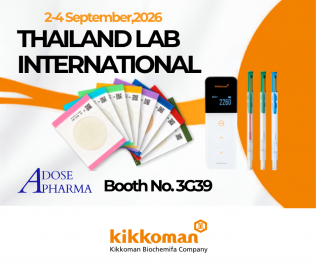
We’re excited to announce that our partner A Dose Pharma will be exhibiting at Thailand LAB INTERNATIONAL, one of Asia’s leading exhibitions for laboratory technology, equipment, and innovation.
A representative from Kikkoman Biochemifa will also be joining the A-Dose Pharma team at the booth!
Stop by and discover Kikkoman’s solutions for hygiene monitoring and microbiological testing:Product
Lumitester Smart & LuciPac A3
High-Sensitivity ATP Test (Kikkoman A3) Is your facility truly clean? Even after visual inspection and standard cleaning, invisible organic residues can remain—posing risks of bacterial contamination, foodborne illness, and allergen cross-contact. The ATP Test (Kikkoman A3) enables ultra-sensitive detection of invisible organic matter (ATP, ADP, AMP), allowing you to verify cleaning effectiveness and reduce risks across food processing, healthcare, and sanitation industries. Paired with Lumitester Smart, our compact, user-friendly luminometer, it provides fast, reliable hygiene monitoring you can trust.
Easy Plate
Next-Generation Microbial Testing Made Easy Easy Plate is a revolutionary, ready-to-use dry culture media that simplifies and accelerates microbiological testing in food safety programs. Validated by AOAC, MicroVal, and NordVal, it supports detection of:
- Aerobic Bacteria
- Coliforms
- E. coli /Coliforms
- Staphylococcus aureus
- Yeast and Mold
- Enterobactericiae
- Listeria
Its stackable film format minimizes storage space and plastic waste while eliminating the need for media preparation. Enhance your workflow further with our Colony Counting System, a free downloadable software that pairs with the ADS-4300N scanner by Brother Industries to automate colony counting—boosting accuracy and efficiency.
-
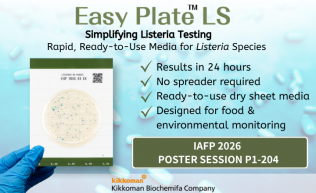
Performance Evaluation of Easy Plate™ LS for Selective Detection of Listeria Species
Introduction:
Listeria monocytogenes is one of the major foodborne pathogens responsible for listeriosis through contaminated food. Environmental monitoring for Listeria species plays a critical role in preventing contamination and controlling the presence of L. monocytogenes. The newly developed ready-to-use (RTU) medium, Easy Plate™ LS, is convenient, environmentally friendly, and enables rapid detection and enumeration of Listeria species within just 24 hours.
Purpose:
The selectivity of Easy Plate™ LS was evaluated and compared with three conventional agar media (ALOA, PALCAM, and a chromogenic agar) and two commercially available RTU media (RTU-A and RTU-B). The inclusivity study included 28 Listeria monocytogenes strains and 20 strains of other Listeria species, while the exclusivity study evaluated 28 non-target strains. Each strain was enriched overnight, diluted in BPW, inoculated at approximately 100 CFU per plate, and incubated at 35 or 37°C for 24, 28, and 48 hours.
Result:
All L. monocytogenes strains were successfully detected on every medium within 24 hours. For other Listeria species, Easy Plate™ LS achieved growth rates of 75% (15/20) at 24 hours and 85% (17/20) at 28 hours, outperforming the two comparator RTU media, which showed approximately 50% recovery at 24 hours. ALOA demonstrated the highest recovery at 90% (18/20), while PALCAM and the chromogenic agar achieved 65–70% recovery at 24 hours. Some species, including L. seeligeri, L. ivanovii, and L. grayi, required extended incubation for optimal recovery. In the exclusivity study, Easy Plate™ LS, RTU-A, and ALOA showed no growth of non-target strains up to 48 hours, whereas prolonged incubation on some other media resulted in the growth of Enterococcus and Bacillus species.
Significance:
Easy Plate™ LS demonstrated high selectivity and reliable detection of Listeria species while minimizing false-positive growth from non-target microorganisms. By eliminating the need for complex media preparation and providing rapid results within 24 hours, Easy Plate™ LS is expected to improve the efficiency and reliability of environmental monitoring programs for Listeria in food production facilities.