


-
Special lecture

Food & Beverage
ATP Depletion-The Risk of False-Negatives in Hygiene Monitoring
Professor and Chair of the Food Science Department University of Wisconsin - Madison Scott A. Rankin, Ph.D.
-
Special lecture
Food & Beverage
Case Study: ATP Test (Kikkoman A3) in food and beverage industry
Director of Key Accounts and Market Segments, Weber Scientific Marybeth Karczynski
-
Introduction of Kikkoman
General Manager, Marketing & Planning Division, Kikkoman Biochemifa Company Mikio Bakke, Ph.D.
Outline
| Product | ATP Test (Kikkoman A3): LuciPac A3 Surface |
|---|---|
| Event date | 2022.08.18 |
Seminar Detail
| Venue | Webinar: Food Safety Magazine |
|---|
Result contents
ATP tests for hygiene monitoring are used in food processing because they are fast, easy to use, and cost-effective. Recent research has characterized the limitations of conventional ATP tests—limitations that can lead to false negative hygiene assessments. The issue relates to the tendency of ATP to degrade in many soils and under common plant environmental conditions. If this depletion occurs, ATP-based assessments become increasingly less sensitive and may yield indications that the surface in question is clean when, in fact, significant levels of soil may still remain. Conditions resulting in ATP depletion are most common in typical manufacturing venues and can result in a false negative in areas sensitive to food hygiene maintenance. This webinar will present recent research from the University of Wisconsin–Madison demonstrating this ATP-depletion phenomenon and how processors can guard against such false negative assessments.
Learning objectives:
- Why ATP tests may show false negative assessments
- Which food, and which food processors, are most at risk for these false negative assessments
- How this issue with ATP may be impacting your sanitation program
Related seminars
-

Gain valuable insights, connect with industry experts, and take your knowledge to the next level
Overview
Allergen cross-contact remains one of the most persistent challenges in food manufacturing—and a single failure can result in costly recalls and long-term brand damage. While visual inspection and conventional hygiene checks are commonly used, invisible residues can still remain on surfaces, posing risks for allergen contamination and foodborne illness. This technical webinar explores how ATP testing can be effectively used as part of an allergen control strategy, with a clear explanation of what ATP testing can and cannot do. Attendees will gain a deeper understanding of surface hygiene monitoring, the role of proper cleaning in preventing cross-contact, and the critical differences between cleaning validation and verification. The session will also highlight why ATP+ADP+AMP total adenylate testing (Kikkoman A3) provides enhanced sensitivity compared to conventional ATP-only methods, enabling detection of a wider range of organic residues relevant to allergen control. A key focus will be on one of the most common challenges in ATP testing: setting appropriate pass/fail limits. Practical approaches for establishing limits, verifying their suitability, and determining revalidation frequency will be discussed, with real-world considerations for food manufacturing facilities.
What You'll Learn
- Why allergen cross-contact occurs even after cleaning
- What ATP testing can and cannot tell you about allergen risk
- The difference between cleaning validation vs. verification
- How ATP+ADP+AMP testing improves residue detection
- Key differences between conventional ATP tests and Kikkoman A3
- How to set, verify, and revalidate ATP pass/fail limits
- Best practices for using ATP testing as part of an allergen management program
Attendance certificates will be issued. On-demand viewing will be available after the live session.
-
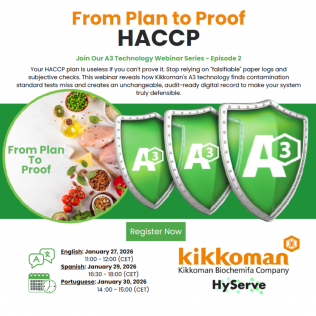
Event Overview
HyServe will be hosting an upcoming webinar as part of the A3 Webinar Series.
Dates and Times (CET):
- English Session: Jan 27, 2026 | 11:00-12:00
- Spanish Session: January 29, 2026 | 16:30 – 18:00
- Portuguese Session: January 30, 2026 | 14:00 – 15:00
Are you confident your HACCP plan can move from a binder on a shelf to verifiable, audit-ready proof in seconds?
Managing food safety with manual logs and subjective visual checks is time-consuming, prone to errors, and difficult to defend during an audit. When a deviation occurs, how quickly can you "close the loop" to prove your corrective action was effective? Join our upcoming webinar to learn how to automate and strengthen your entire food safety program. We will explore how Kikkoman's A3 technology and the Lumitester App directly support the most critical "action" principles of HACCP—Monitoring, Corrective Actions, and Verification.
What You Will Learn
In this webinar, we will cover:
- Why Superior Sensitivity Matters: How Kikkoman's A3 technology (measuring ATP+ADP+AMP) finds contamination from processed or heated foods that standard ATP-only tests miss.
- Automate Monitoring (Principle 5): Move from subjective "visual checks" to objective, numerical RLU data for a consistent standard of "clean".
- "Close the Loop" on Corrective Actions (Principle 6): Use real-time results to trigger an immediate corrective action (re-clean) and instantly re-test to verify it was successful.
- Achieve Total Accountability (Principle 7): Eliminate "messy, error-prone, and falsifiable" paper logs. See how every test is automatically saved to the cloud with the operator ID, time, date, and location, creating an unchangeable, audit-ready digital record.
- Verify Your System: Use the app's data to instantly identify sanitation trends, validate cleaning procedures, and prove your HACCP plan is working effectively.
Target Audience
- Quality Assurance Managers
- HACCP Coordinators
- Food Safety Professionals
looking to save time, reduce risk, and create a truly defensible food safety system.
Speaker Information
- Jorge E. Padilla
- Stella Maciel
-

- Event date
- 2025.07.31
- Product
- ATP Test (Kikkoman A3): LuciPac A3 Surface, LuciPac A3 Water, LuciPac A3 Pre-moisten
- Venue
- Microsoft Teams